



 25064
 71
 -19

A TAPU, or cadastral title, is the main document confirming ownership of property, a kind of title of ownership. In Turkish, it is called a tapu senedi, and all transactions with it are registered by the Land Registry Office (Tapu Müdürlüğü).
A TAPU gives absolute ownership of the property, which cannot be challenged after the sale is concluded. More precisely, the law protects a good-faith buyer who relied on the entry in the register (Article 1023 of the Turkish Civil Code). An entry can be challenged in court only in special cases, for example if documents were forged, which is why the seller's TAPU is checked before the deal.
Contents:
- Types of TAPU
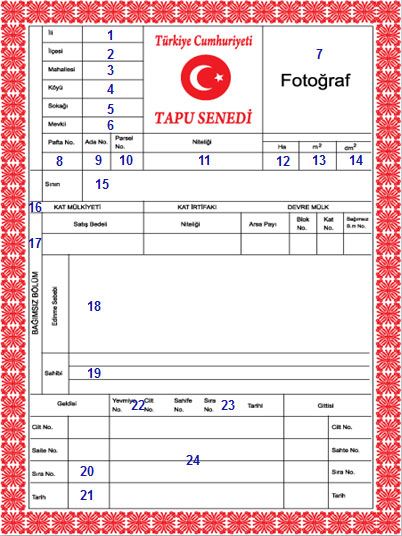
- Red TAPU: issued for an apartment or other unit in a completed building or one under construction.
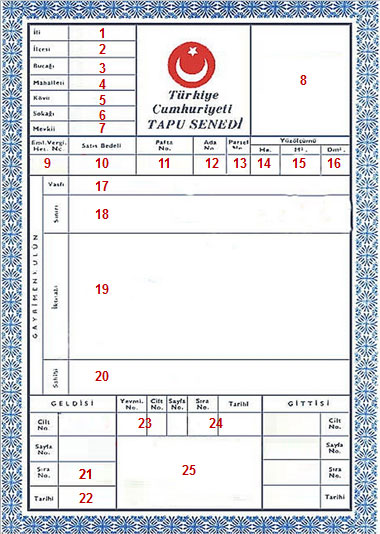
- Blue TAPU: issued for a plot of land without any buildings:
- Documents and costs of registering a TAPU in 2026
- Important to know.
- When a TAPU with kat irtifakı may not suit
- Frequently asked questions
Types of TAPU
| Type | Color of the deed | What it is issued for |
|---|---|---|
| Kat mülkiyeti | Red | An apartment in a completed building with an occupancy permit (iskan): full ownership |
| Kat irtifakı | Red | An apartment in a building under construction or without an iskan: a right to the future apartment with a share in the land |
| Devre mülk | Red | The right to use a home during a certain period of the year (timeshare) |
| Arsa / tarla | Blue | A plot of land, including agricultural land |
| Hisseli tapu | Depends on the property | A share in a jointly owned plot or property held by several owners |
New-style TAPUs include a QR code (which opens the plot on a map at parselsorgu.tkgm.gov.tr), a property number and gross and net area, and the type of ownership, kat irtifakı or kat mülkiyeti, is written out in words.
Red TAPU: issued for an apartment or other unit in a completed building or one under construction.
For a completed building with an iskan, this is kat mülkiyeti. For a building under construction, it is kat irtifakı: it is established on a plot where the building has not yet been built or completed, and once the iskan is issued, it is converted to kat mülkiyeti.
1. Region
2. City
3. Neighborhood
4. Locality
5. Street
6. Location
7. Owner's photo
8, 9, 10 Plot coordinates
11. Status of the land plot (according to Land Registry information)
12, 13, 14, 15 Area of land belonging to the new owner (in proportion to the size of the home purchased)
16. Status of the property belonging to the new owner (type of ownership)
17. Price of the property purchased
18. Information about the previous owner(s)
19. Information about the new owner(s)
20. TAPU number at the previous owner's registration (changes with each transfer of ownership)
21. Date the previous owner acquired the property
22. Registration details of the new TAPU document
23. Date the new owner acquired the property
24. Seal and signature of the director of the Land Registry Office
Ownership is registered at the Land Registry office where the property is located. The buyer and the seller sign a deed stating that they have no claims against each other in the presence of a sworn translator, after which ownership is transferred. The new owner is entered in the land register and is issued the cadastral title, the TAPU, the certificate of ownership of the property. Usually the transaction at the Land Registry takes one visit, and it takes a few days from the application to the issue of the TAPU.
Blue TAPU: issued for a plot of land without any buildings:
1. Region
2. City
3. District
4. Neighborhood
5. Locality
6. Street
7. Location
8. Owner's photo
9. Tax number
10. Assessed value
11, 12, 13 Plot number
14, 15, 16 Area of the property
17. Type of property
18. Plot boundary
19. Reason for acquisition
20. Owner
21. TAPU number at the previous owner's registration (changes with each transfer of ownership)
22. Date the previous owner acquired the property
23. Registration details of the new TAPU document
24. Date the new owner acquired the property
25. Seal and signature of the director of the Land Registry Office
The two lists have a different number of items, and this is not a mistake: the deeds are laid out differently. The blue TAPU has fields that the red one does not: district, tax number, assessed value and reason for acquisition.
Documents and costs of registering a TAPU in 2026
For the transaction at the Land Registry, a foreign buyer will need:
- a passport and a Turkish tax number;
- photos for the TAPU;
- a valuation report from an SPK-licensed company, which is mandatory for foreigners and valid for 3 months;
- an earthquake insurance (DASK) policy for a completed home;
- receipts for payment of the title deed transfer fee and the Land Registry fee;
- a power of attorney, if a representative carries out the transaction.
| Cost | Amount in 2026 |
|---|---|
| Title deed transfer fee (tapu harcı) | 4% of the price, not less than the tax value; by law split equally, 2% each, between the buyer and the seller |
| Land Registry fee (döner sermaye) | TRY 20,870 |
| Valuation report | At the valuation company's rate |
| DASK insurance | TRY 500–3,000 a year |
| Sworn translator | At the translator's rate |
After the transaction, the annual property tax and the aidat, a fee for maintaining the complex whose amount is approved by the owners' meeting, are added to the costs.
Important to know.
- When the document transferring ownership from the seller to the buyer is signed, all parties to the transaction or their representatives must be present.
- Make sure a translator is present if the transaction involves a foreigner. The translator must be a sworn translator: the Land Registry works with translators from the official regional list of experts.
- Check that the actual address of the property matches the one stated in the TAPU. On new deeds, this is easy to check using the QR code.
- Check that the TAPU is legally clean and find out whether there are any encumbrances on it: a mortgage, pledge, debt obligations, partial alienation, gift agreement or seizure. An up-to-date statement of encumbrances (takyidat belgesi) is issued by the Land Registry Office; it is also worth checking the property's designation: "home" (konut) or commercial premises.
- When buying residential property at the construction stage, make sure the construction company in Turkey has a building plan and a building permit. When buying a completed home, check that there are no unpaid taxes or water and electricity bills. We have covered all the stages of the deal in order in our article on the property buying process in Turkey.
- A lost TAPU can be restored. To do this, you will need to pay a state fee. Ownership is not lost: it is recorded in the electronic register, and the owner can see information about their properties in the e-Devlet system.
"Before paying a deposit, we advise asking the seller for a copy of the TAPU and immediately ordering a statement of encumbrances from the Land Registry. If the TAPU says kat irtifakı but the building has already been completed, it is worth asking when the iskan will be issued: mortgages and utility connections depend on it," says a sales manager at Yekta Homes.
When a TAPU with kat irtifakı may not suit
- Those buying with a mortgage. Banks usually lend on completed buildings with an iskan, that is, with a kat mülkiyeti TAPU.
- Those who want to move in right away. Without an iskan, the building cannot be officially connected to utilities.
Both situations can be seen from the TAPU in advance. In such cases, buyers choose an apartment in a completed building or check with the developer in advance when the iskan will be obtained.
Frequently asked questions
What is a TAPU in simple terms?
A certificate of ownership of property in Turkey. It is issued by the Land Registry Office after the transaction is registered.
How is a red TAPU different from a blue one?
A red TAPU is issued for apartments (kat mülkiyeti and kat irtifakı), and a blue one for land plots.
How much does it cost to register a TAPU?
The title deed transfer fee is 4% of the price (by law split equally with the seller), the Land Registry fee in 2026 is TRY 20,870, plus a valuation report, DASK insurance and a translator.
How long does it take to register a TAPU?
Usually a few days from the application; the transaction itself at the Land Registry takes one visit.
What should you do if a TAPU is lost?
Order a duplicate from the Land Registry Office. Ownership is not lost, as it is recorded in the register.
If you are buying an apartment together with a spouse or relatives, they can be added to the document right away. We have explained separately how to do this and whether you can add a co-owner to the TAPU after the purchase.


